

You sit down to study at 7 p.m. planning to finish a whole chapter, and by 9 p.m. you have reread the same page four times and answered three messages. The problem is rarely laziness: “study for two hours” is too big, too vague, and too easy to drift away from. The Pomodoro method for students fixes that by shrinking study into short, timed sprints: 25 minutes of focused work, a 5-minute break, and repeat. This guide explains what the method is, how to use it in exactly 5 steps, what a real study day looks like, which apps are worth trying, and the mistakes that make most students quit after a week.

What Is the Pomodoro Method?
The Pomodoro method is a time management technique created by Francesco Cirillo in the late 1980s, when he was a university student struggling to focus. He used a tomato-shaped kitchen timer — pomodoro is Italian for tomato — to work in short, fixed bursts. Each 25-minute burst is called a pomodoro.

The classic cycle:
- Focus for 25 minutes on one single task, with no interruptions.
- Take a 5-minute break — stand up, stretch, drink water, rest your eyes.
- Repeat. After 4 pomodoros, take a longer break of 15 to 30 minutes.
Four pomodoros give you 100 minutes of real, focused work in about two hours, including breaks — often more learning than a whole evening of distracted “studying” with your phone beside you.
Two rules make it a method rather than just a timer. First, a pomodoro is indivisible: if you stop halfway, that pomodoro does not count. Second, record every finished pomodoro — after two weeks you will know a maths problem set takes about 3 pomodoros, not the 1 you hoped for.
Why the Pomodoro Method Works for Students
The method works because it attacks the three things that ruin most study sessions: starting, drifting, and burning out.
Starting becomes easy. “Study for 25 minutes” is a small promise your brain stops arguing with. “Revise for finals” feels like a mountain; one pomodoro feels like a single step.
Your attention stays fresh. Sustained attention fades over time, and brief breaks help restore it. A 2023 study of 87 university students found that students on fixed, Pomodoro-style breaks reported less fatigue and more concentration than students who chose their own breaks, and finished the same work in less time.
Progress becomes visible. “I did 6 pomodoros today” is a real achievement you can count. “I studied for a bit” is not. Counting rounds also exposes how much students underestimate task times, and your estimates get steadily more accurate.
One honest warning: the timer manages your time, not your learning. Four pomodoros of rereading are still mostly rereading. Fill each block with active work — practice questions, flashcards, problem sets, or explaining a topic from memory. Our guide on study tips to boost your grades pairs well with this one.
How to Use the Pomodoro Method for Students in 5 Steps
Here is the full method in the 5 steps that matter. You need only a timer, a pen, and a piece of paper.

Step 1: Pick one task and make it concrete
Choose a single task with a visible finish line. “Study biology” is not a task. “Answer the 12 end-of-chapter questions for chapter 6 without notes” is. If a task needs more than 4 or 5 pomodoros, split it into smaller pieces. If it takes less than one pomodoro, group it with similar small jobs, such as printing notes and checking the course portal.
Step 2: Set the timer for 25 minutes
Set a timer for 25 minutes and commit to working until it rings. Before you start, silence your phone and put it out of reach, close every tab that is not study material, and keep water on your desk.
Step 3: Work on that one task until the timer rings
Work only on the task you chose. Do not switch tasks or check messages. When a distracting thought pops up, write it on a scrap of paper and go straight back to work; deal with the list during your break. If you finish early, use the leftover minutes to review your answers or quiz yourself. Do not start a new task mid-pomodoro.
Step 4: Mark the pomodoro and take a 5-minute break
When the timer rings, stop, tick off one pomodoro, and take a real 5-minute break immediately. Stand up, stretch, refill your water, look out of a window. Do not finish “just one more thing” — the method only works when you rest on time. Keep breaks screen-free: a five-minute scroll rarely stays five minutes.
Step 5: After 4 pomodoros, take a longer break
After 4 pomodoros, take a longer break of 15 to 30 minutes. Eat something, go outside, or lie down. Do not skip it to squeeze in a fifth round — your later rounds will get sloppier and you will learn less. After the long break, start a fresh set of 4, or stop and review your count.
A Sample Pomodoro Study Schedule for Students
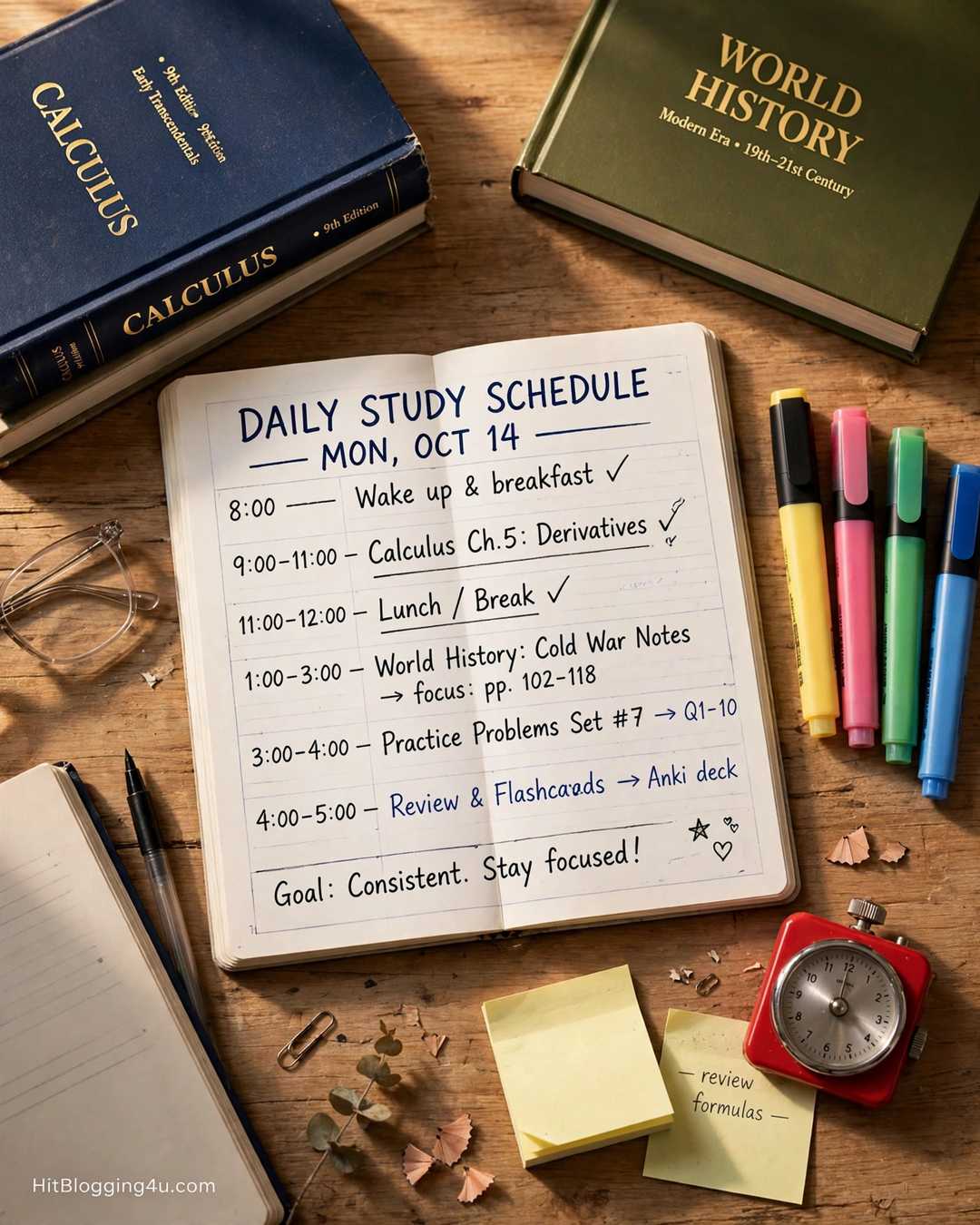
Here is a copy-ready schedule for a full study day: 8 pomodoros, about 3 hours and 20 minutes of focused work, starting at 4:00 p.m. It mixes two subjects, harder one first, with a proper long break after the fourth round.
| Time | Pomodoro | Task | How to study |
|---|---|---|---|
| 4:00 – 4:25 p.m. | 1 | Physics concepts | Write key formulas from memory, then check |
| 4:30 – 4:55 p.m. | 2 | Physics problems, part 1 | Solve without looking at your notes |
| 5:00 – 5:25 p.m. | 3 | Physics problems, part 2 | Finish the set and mark your errors |
| 5:30 – 5:55 p.m. | 4 | Physics error review | Redo every problem you missed |
| 5:55 – 6:25 p.m. | Long break | Rest | Eat, walk outside, no screens |
| 6:25 – 6:50 p.m. | 5 | Biology flashcards | Test yourself on the full deck |
| 6:55 – 7:20 p.m. | 6 | Biology diagrams | Label cell diagrams from memory |
| 7:25 – 7:50 p.m. | 7 | History essay outline | Write your thesis and main points |
| 7:55 – 8:20 p.m. | 8 | History essay sources | Gather sources and note key quotes |
Short on time? Three pomodoros are enough for a solid session: about 85 minutes including breaks, for 75 minutes of focused work. On a normal class day, 4 to 8 pomodoros is realistic; on a full study day, 8 to 12 is heavy. Beginners should start with just 2 to 4 a day and build up.
If you also juggle a job alongside classes, fit your pomodoros around your shifts instead of hoping to find time later. Our guide on how to balance a part-time job and your studies shows how to block study time into a working week: decide your pomodoros in advance, put the hardest subject in your sharpest hours, and keep one buffer slot per day.
Best Pomodoro Apps and Tools for Students
You do not need an app — a kitchen timer works exactly as Cirillo intended, with no notifications. But a good app records your sessions automatically, and some block distractions. Here are 5 options students actually stick with.

1. Pomofocus — best free, no-setup timer
Pomofocus is a free, clean timer that runs in your browser — no account, no download. You can customise the work and break lengths, add a task list, and track a daily goal. It is the fastest way to start, though other browser tabs can still tempt you.
2. Forest — best if your phone is the problem
Forest turns focus into a game: you plant a virtual tree when a session starts, and it grows while you focus — but it withers if you leave the app. The company also plants real trees. It is free with ads on Android, with a paid version on iOS, and it is the best pick if you keep picking up your phone mid-session.
3. Focus To-Do — best for task lists
Focus To-Do combines a Pomodoro timer with a full task manager. You assign an estimated number of pomodoros to each task, track completions, and get white noise to help you concentrate. It works across iOS, Android, Mac, Windows, and the web, with a free tier and a premium upgrade.
4. Focus Keeper — best for customisation
Focus Keeper offers a visual timer wheel, streaks, custom work and break lengths, and focus sounds, on iOS, Android, and the web. The free tier covers the core timer; detailed statistics need the paid upgrade. It suits students who like to tune the method, for example switching to 50-minute rounds for essays.
5. A physical timer — best for a phone-free desk
A kitchen timer or a visual timer, such as a Time Timer that shows remaining time as a shrinking coloured disk, removes notifications completely. The trade-off is that it keeps no automatic log, so record your pomodoros on paper. If a tight budget is the reason you want a free timer, our simple student budget guide can help you plan your month first.
6 Common Pomodoro Mistakes Students Make
The method is simple, which makes it easy to use badly. These are the 6 mistakes that cause most students to quit.

1. Spending breaks on your phone
Five minutes of scrolling rarely stays five minutes, and even when it does, you return with your head full of other things. Keep breaks screen-free: stand, stretch, drink water, look out of a window.
2. Not deciding what the round is for
“Study chemistry” is too vague to act on. Before you start the timer, know exactly what you will do: “Balance 12 equations from worksheet 3.” Clear tasks make each round count, and vague tasks make each round drift.
3. Pausing the timer for every small interruption
If you pause and resume constantly, the round loses its meaning. Cirillo’s original rule is that a pomodoro cannot be split: if you are truly interrupted, abandon that round and start a fresh one later. Write small urges on your distraction list instead of acting on them.
4. Skipping the long break
After 4 rounds, your focus needs a proper rest. Skipping the long break might feel productive, but your later rounds get sloppier and you retain less. The long break is part of the method, not a reward for finishing it.
5. Planning too many pomodoros
Writing “12 pomodoros” on a normal school day sets you up to feel like you failed. Plan a number you can actually hit — 4 to 6 on a class day is a good start — then add more if you have energy left. A realistic daily number you hit every day beats an ambitious one you abandon by Wednesday.
6. Filling pomodoros with passive rereading
A timer guarantees focus on something; it does not guarantee the something is useful. Research rates practice testing and spreading study over time as the two highest-utility methods, while rereading and highlighting rate low. Spend your blocks answering questions from memory, then checking. And if you want your focused hours to pay, see how to start freelancing as a student with no experience.
Pomodoro Variations: When 25 Minutes Is Not Right
Twenty-five minutes is a starting point, not a law. The right length is the one you can protect completely — a 50-minute block you keep checking your phone in is worse than a 25-minute block you actually spend on the task.
| Variation | Focus / break | Best for | Watch out for |
|---|---|---|---|
| Short pomodoro | 15 min / 3 min | Days you really cannot get going; dreaded tasks | Not much time for complex work |
| Classic pomodoro | 25 min / 5 min | Getting started, flashcards, drills, problem sets | Can feel too short for deep writing |
| Long pomodoro (50/10) | 50 min / 10 min | Essays, coding, long problem sets, dense reading | Harder to start when motivation is low |
| 45/15 | 45 min / 15 min | Complex problem-solving that needs warm-up time | Breaks can stretch if you are not strict |
| Flowtime | Work until focus fades | Creative work when you are already in flow | Easy to work for hours without a real break |
A practical mix: start the day with a couple of 25-minute rounds to build momentum, then switch to 50-minute rounds once you are warmed up. During exam week, shift toward practice and review blocks, simulate the exam once a week with a full timed past paper, and shorten intervals to 20/5 when you are tired. The night before an exam, do a light review pomodoro or two — then sleep.
Conclusion: Start With One Pomodoro Today
The Pomodoro method for students works because it makes studying small, timed, and countable. Pick one concrete task, set a timer for 25 minutes, work without distractions, then take a real break. After 4 rounds, rest properly. Adjust the timing to suit the task and fill each block with active recall instead of rereading.
Your next step: choose one task you have been putting off, write down exactly what you will do in a single round, and set a 25-minute timer right now. When it rings, you will already be further along than you were.
Frequently Asked Questions
How many pomodoros should a student do in a day?
Most students find 4 to 8 focused rounds a day is plenty on top of classes; exam weeks might stretch to 8 to 12. Start with 4, count how many you actually complete, and raise the number slowly.
Does the Pomodoro method actually work for studying?
For most students, yes — mainly because it makes starting easier and breaks regular. A 2023 study of 87 university students found fixed Pomodoro-style breaks were linked to less fatigue and better motivation than self-chosen breaks. But the timer alone does not teach you anything: what you do inside each block — practice questions, flashcards, recall from memory — decides how much you learn.
What should I do during a 5-minute Pomodoro break?
Stand up, stretch, refill your water, and look away from screens. Avoid your phone: a five-minute scroll rarely ends on time. On the long break, eat something or go outside.
Can I use the Pomodoro method for reading?
Yes, if you give each block an output. Set a goal such as one chapter section, then spend the last few minutes writing a short summary from memory. That turns passive reading into active recall. For dense texts, try a longer 40- to 50-minute round with a 10-minute break.
What if I finish my task before the timer rings?
Use the remaining minutes to review: check your answers, quiz yourself, or tidy your notes. Cirillo recommends this overlearning in leftover time rather than starting a new task mid-pomodoro.
Is 25 minutes too short to get anything done?
For many tasks it is exactly right, especially when you are struggling to start. For writing, coding, or long problem sets, you may find you are only just warmed up when the timer rings — that is a sign to try 50-minute rounds with 10-minute breaks.