

Figuring out how to balance work and study is one of the hardest parts of student life. Your shifts clash with lectures, assignments pile up during your busiest work weeks, and by Friday you are too tired to study at all. The good news is that thousands of students manage it every semester — not by working harder, but by running a simple system: the right number of hours, a weekly plan, honest conversations with their employer, and study methods that fit around shifts. This guide walks you through that system step by step, with a sample weekly schedule you can copy.

If you are still looking for work that fits around classes, start with our list of 10 part-time remote jobs for students that actually pay — flexible, remote roles are much easier to balance than fixed on-site shifts.
How to Balance Work and Study in 7 Practical Steps
Balance is not about perfect time management. It is about making a small number of decisions in advance, so you are not renegotiating your whole week every single day. Work through these seven steps in order.
Step 1: Do the Hours Math Before You Take Extra Shifts
Before you accept more hours, add up your week honestly. A full-time course load usually needs 15 hours of class plus 20 to 30 hours of studying. Add your work hours, then add 56 hours of sleep (8 hours a night). If the total passes 110 hours, something has to give — usually your grades or your health.
Research on student employment points to a clear pattern: working up to 15 hours a week has little or no negative effect on grades, and many students actually do better because the structure forces them to plan. Past 20 hours a week, academic performance usually starts to slide. Treat 10 to 15 hours as your sweet spot during term time, and treat 20 hours as a hard ceiling unless your course load is light.
Run this check at the start of every semester, not in the middle of exam season. If the math does not work, the answer is fewer hours, a different job, or a lighter course load — not less sleep. And if money is tight, a small buffer helps: here is how to build a small emergency fund on a student income, so one unexpected expense does not force you into extra shifts.
Step 2: Build a Weekly Schedule Around Your Shifts
Most schedules fail because they are built for a week that does not exist. Build yours from the fixed blocks outward: first classes, then confirmed work shifts, then sleep. Everything else — study, meals, rest — fills in around them.
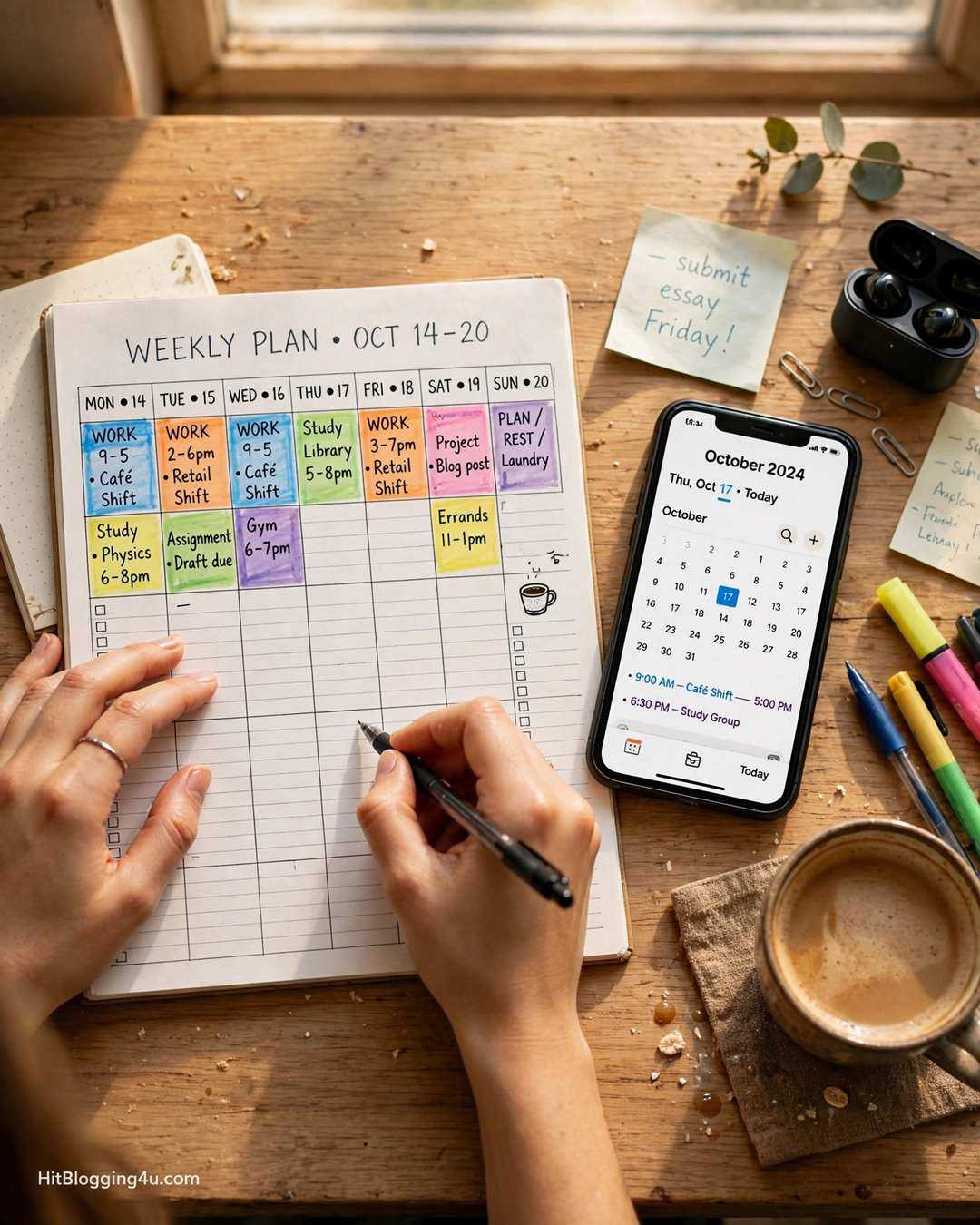
Do this every Sunday evening for the week ahead. It takes 15 minutes and it prevents the Thursday-night panic of discovering an assignment is due on Friday. Put every deadline on the same calendar as your shifts, so you can see clashes a week early instead of the night before.
Two rules make the schedule hold:
- Assign subjects, not just “study time.” “Monday 7–8:30 PM: biology revision” gets done. “Study tonight” does not.
- Keep one buffer block. Leave one evening or half-day each week unscheduled. That is your catch-up slot for the assignment that ran long or the shift that ran late.
Step 3: Use Time Blocking to Protect Study Hours
Time blocking means giving every task a fixed slot on your calendar instead of keeping a to-do list that never ends. It is the single most useful skill when you are learning how to balance work and study on a tight schedule, because it turns vague intentions into appointments you keep.

Here is how to set it up:
- Block your classes and shifts first — these are non-negotiable.
- Add study blocks of 60 to 90 minutes in the gaps, and name the subject and the task for each one.
- Protect the hour before a shift, not just after it. Studying from 2 to 4 PM before a 5 PM shift is usually far more productive than studying from 9 to 11 PM after it, when you are already drained.
- Colour-code work, study, and rest in your calendar app so you can see at a glance whether the week is actually balanced.
Use a free tool like Google Calendar and set a reminder 15 minutes before each block. If you want work that needs even fewer fixed hours, check out the best side hustles for students with only 5 hours a week — flexible gigs fit a time-blocked schedule far better than rigid shifts.
Step 4: Talk to Your Employer About Exam Season — Early
Most student-friendly employers expect this conversation. They hired you knowing you are a student. What they do not expect is to hear about it the night before your exam. Bring it up at the start of the semester, not during finals week.

Be specific. “I need more flexibility” is easy to ignore. “I cannot work past 9 PM during the week of 12 May, and I need the 14th off for my final exam” is a request a manager can actually plan around. Bring your class timetable and your exam dates, and ask for:
- A standing weekly schedule instead of a rota that changes every week
- No closing shifts the night before an exam
- Reduced hours during your two heaviest exam weeks, with the option to pick up extra shifts afterwards
Here is a script you can use: “Hi, I really enjoy working here and I want to keep my shifts consistent. My exams run from 12 to 19 May. Could we plan around that — no late shifts that week, and I can cover extra weekend shifts in June to make up the hours?” Offering a swap shows you are a team player, and managers remember it. If an employer refuses every reasonable request, that tells you something important about the job — and it may be time to look for one that respects your studies.
Step 5: Use Study Techniques That Fit Around Shifts
When your study time is limited, quality matters more than quantity. Re-reading notes for three tired hours after a shift achieves less than 90 focused minutes done properly. These three techniques are built for short windows:

- The Pomodoro Technique: study in 25-minute bursts with a 5-minute break, and take a longer 20 to 30-minute break after four rounds. It works especially well when you only have an hour between class and a shift.
- Active recall: close your notes and test yourself — write summaries in your own words, make practice questions, or explain the topic out loud as if teaching a classmate. Testing yourself beats re-reading every time.
- Micro-sessions: a 30 to 45-minute gap between class and work is enough to review flashcards, read one textbook section, or draft a paragraph. Keep a running list of 20 to 40-minute tasks that need no setup, and pick one the moment a gap appears. Your commute counts too — 20 minutes of audio revision each way adds up to over three hours a week.
Match the task to your energy. Do your hardest subject in your peak-focus window — usually mid-morning — and save light tasks like organising notes or reviewing flashcards for after a shift. Forcing hard revision when you are exhausted just creates hours that feel like studying but teach you nothing.
One of the most flexible ways to earn while you study is tutoring, because you set the hours yourself. See how to become an online tutor as a college student if your current shifts keep clashing with classes.
Step 6: Protect Your Sleep and Spot Burnout Early
The honest truth about how to balance work and study is that rest is part of the system, not a reward for finishing it. Sleep is what makes the schedule work: cut it below seven hours a night and your memory, focus, and mood all drop — which makes both your job and your classes harder.

Watch for these warning signs that the load has become too much:
- You are regularly missing deadlines or skipping classes to rest
- You sleep fewer than six hours a night for more than a week
- You feel exhausted even after a full night’s sleep
- You dread both work and study, and small tasks feel overwhelming
If two or more of these are true, the schedule is not fixable with better technique — the hours are simply too many. Cut back your work hours, talk to your academic advisor about dropping a course, or take a lighter semester. These are resource-management decisions, not failures. And protect one full rest block every week: a day, or at least a long evening, with no work and no structured study. Students who rest deliberately come back sharper than students who grind through it.
Step 7: Review and Adjust Every Sunday
No plan survives contact with a real semester unchanged. Every Sunday, spend ten minutes reviewing the week: which study blocks actually happened, which shifts overran, and what is due next week. Move the blocks that keep failing instead of blaming yourself for them — a study slot that fails three weeks in a row is a bad slot, not a lack of discipline. Small weekly corrections keep a workable system working; waiting until midterms to fix it is usually too late.
A Sample Weekly Schedule: 12 Work Hours Plus Full-Time Classes
Here is what a balanced week can look like for a student with 15 class hours and a 12-hour part-time job. Copy it and adjust the times to your own timetable.
- Monday: classes 9 AM–1 PM, study block 2–4 PM (hardest subject), work shift 5–9 PM.
- Tuesday: classes 10 AM–2 PM, study block 3–5 PM, free evening for rest and friends.
- Wednesday: classes 9 AM–12 PM, micro-study 1–1:45 PM, work shift 2–6 PM, light review 7–8 PM.
- Thursday: classes 10 AM–1 PM, study block 2–4:30 PM, work shift 5–9 PM.
- Friday: classes 9 AM–12 PM, study block 1–3 PM, work shift 4–8 PM.
- Saturday: work shift 10 AM–2 PM, study block 3:30–5:30 PM, free evening.
- Sunday: buffer morning (catch up on anything that slipped), weekly planning 4–4:30 PM, full evening off.
That is 15 class hours, 12 work hours, about 12 focused study hours, and a full day of rest built in. The exact times matter less than the pattern: fixed blocks first, named study tasks, a buffer, and one real day off. If your numbers are bigger than this, revisit Step 1 — the hours math comes before the schedule, not after it. And remember that your money plan matters as much as your time plan: the simple student budget shows you how to plan your month step by step, so you know exactly how many work hours you actually need.
Signs You Are Working Too Many Hours
Sometimes the problem is not your system — it is the sheer number of hours. A full-time course load needs roughly 30 to 45 hours a week of classes plus study. Add a 20-hour work week and you are at 50 to 65 hours of structured obligation before meals, commuting, or rest. If you are missing deadlines, falling behind in more than one course, or running on under six hours of sleep, consider reducing your hours, switching to a more flexible job, or dropping to a part-time course load for one semester. Talk to a financial aid counsellor before making big changes, since aid can be affected by income and enrolment — but know that a one-semester adjustment is usually recoverable, while a damaged GPA is much harder to repair.
Frequently Asked Questions
How many hours a week can a student work without hurting their grades?
Most research suggests up to 15 hours a week has little or no negative effect on grades, and some students even benefit from the structure. Past 20 hours a week, academic performance usually starts to decline. The right ceiling also depends on your course load — a lighter semester can absorb more work hours than a heavy one.
How do I balance a part-time job and my studies during exams?
Plan at least three weeks ahead. Map your exam dates against your shifts, request reduced hours for your heaviest exam days early, and use the weeks before exams to get ahead on routine coursework. Ask for no closing shifts the night before an exam, and offer to cover extra shifts after exams finish.
How do I ask my employer for fewer hours during exam season?
Be specific and give plenty of notice. Bring your exam timetable, name the exact dates you need off or need shorter shifts, and offer a swap — for example, extra weekend shifts after exams. Most employers who hire students expect this conversation, and a concrete request is far easier for a manager to approve than a vague ask for “flexibility.”
What is the best way to study when you work part-time?
Use short, focused methods instead of long tired sessions. Study in 25-minute Pomodoro bursts, test yourself with active recall instead of re-reading, and use 30 to 45-minute gaps between class and shifts for micro-sessions like flashcards. Study before a shift when your energy is higher, and save light review tasks for after work.
How do I stop feeling burned out from work and study?
Protect seven to eight hours of sleep every night, keep one full rest block each week with no work or study, and eat properly between shifts. If you are missing deadlines, sleeping under six hours a night, or dreading both work and study, the hours are too many — cut back your shifts or lighten your course load rather than pushing through.
Is working while studying worth it?
Yes, for most students — if the hours stay reasonable. A part-time job brings income, work experience, and stronger time-management skills, and students working 10 to 15 hours a week often perform as well as, or better than, students who do not work at all. The benefits disappear when hours climb past 20 a week and start crowding out classes, study, and sleep.
Once you know how to balance work and study, the job stops feeling like the enemy of your grades and starts feeling like part of your student life. Start with the hours math, block your week on Sunday, talk to your employer before exam season, and protect your sleep like it is a class you cannot skip. If the numbers do not add up, change the numbers — not your health.