

So you have a skill, a few sample pieces, and maybe even a client asking for your price — and now comes the question every student freelancer dreads: how much should a student freelancer charge per hour? Charge too little and you work all week for pocket money. Charge too much and the client disappears. The good news is that pricing is not guesswork. There are real market rates for student work, a simple formula for your first rate, and a clear path to raising it.
This guide gives you the actual numbers students are charging in 2026, a step-by-step way to set your first rate, and the rules for raising it without losing clients.
The Short Answer: What Student Freelancers Actually Earn
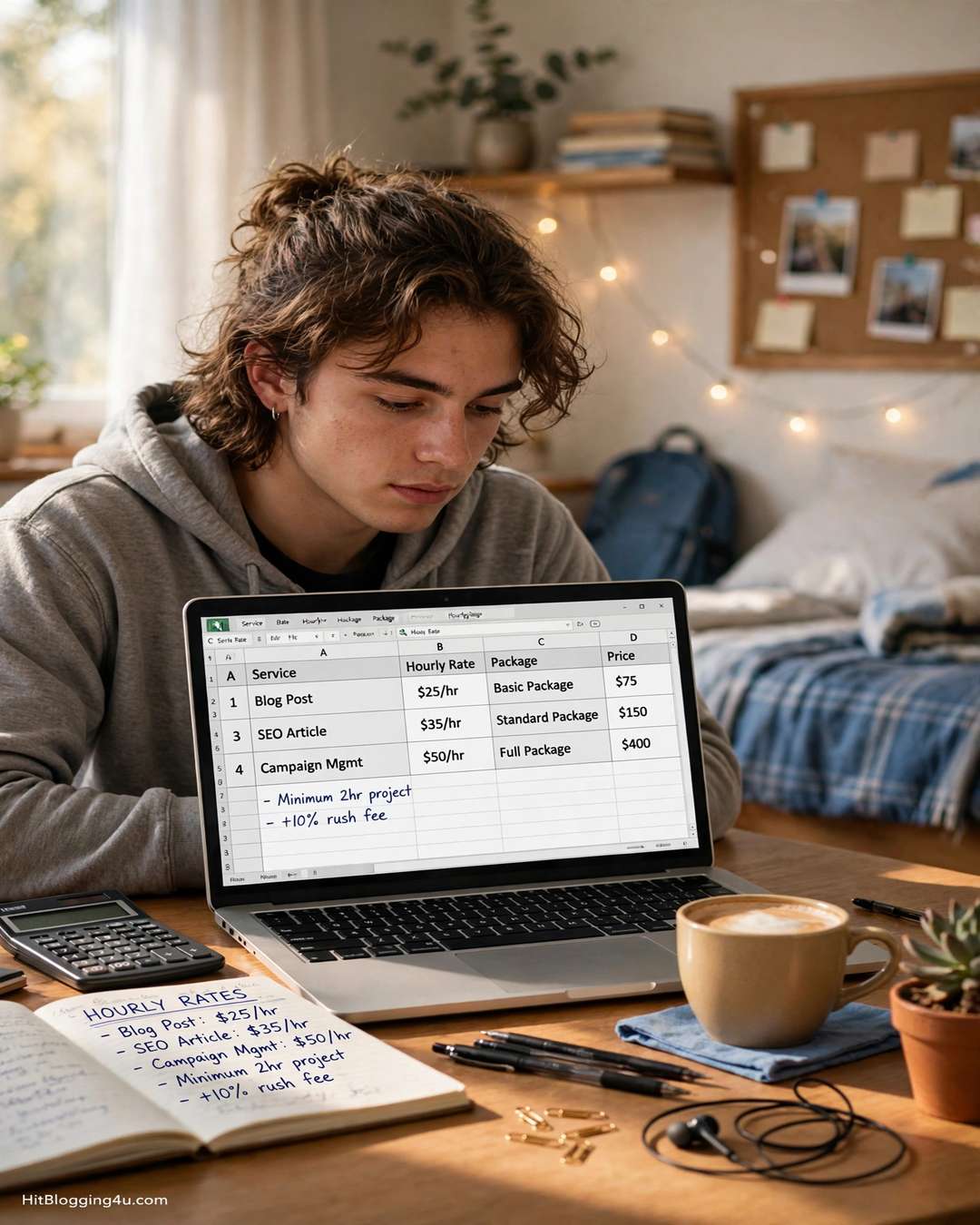
Most student freelancers earn between $15 and $50 per hour, depending on the skill. Beginners with no reviews usually start at the low end; students with five or more good reviews and a strong portfolio sit at the high end. Here are realistic 2026 starting rates by skill:

| Skill | Beginner rate | With reviews |
|---|---|---|
| Content writing | $15–$25/hr | $40–$75/hr |
| Graphic design (Canva) | $20–$35/hr | $50–$75/hr |
| Video editing | $20–$40/hr | $50–$80/hr |
| Virtual assistance | $15–$25/hr | $30–$50/hr |
| Social media management | $18–$40/hr | $50–$90/hr |
| Online tutoring | $18–$30/hr | $40–$60/hr |
| Data entry | $10–$15/hr | $20–$30/hr |
These are gross rates, before platform fees and tax. A $25 hourly rate on a platform that takes 20% is really $20 in your pocket — and the section on fees below shows how to account for that. If you have not picked your skill yet, read our guide to 7 freelance skills students can learn in 30 days first, then come back and price it.
The 3-Part Formula for Your First Rate

Instead of copying someone else’s number, build your rate from three parts:
1. Your floor. Work out the lowest rate that makes the job worth your time. Take the monthly money you need from freelancing, divide it by the hours you can actually work, and add a little for tax. Example: you want $400 a month and can work 20 hours a month. Your floor is $20 per hour. Never accept work below your floor — it costs you study time for nothing.
2. The market. Search Upwork or Fiverr for your exact service and look at freelancers with real reviews and steady work — not the cheapest listings. Your starting rate should sit just below theirs, not far below. If experienced writers charge $40, starting at $20–$25 is reasonable. Starting at $5 signals that your work is worth $5.
3. Your proof. No reviews yet? Price for your first three gigs only, and treat them as paid portfolio-building. Strong samples let you charge more than a beginner with nothing to show. If you have no samples yet, build three practice pieces this week — our guide to how to start freelancing as a student with no experience shows exactly how.
Put the three together: a rate above your floor, just below the market rate of reviewed freelancers, adjusted up if you have strong samples. That number is your starting rate. Write it down and do not negotiate below it.
Hourly vs Project Pricing: Which Pays Students More?
Hourly pricing is simple and fair for open-ended work like virtual assistance or ongoing social media management. But it has a built-in punishment: the faster you get, the less you earn. A blog post that took you three hours as a beginner takes one hour once you are good — and your pay drops by two-thirds.
Project pricing fixes this. You charge for the result, not the time. A logo, a blog post, or a month of social media posts has one price, agreed before you start. Most experienced freelancers prefer project pricing, and students should switch to it as soon as they can estimate how long a job takes.
The rule of thumb: charge hourly for your first few gigs while you learn how long things take, and for ongoing work with no clear end. Charge per project for anything with a clear deliverable once you know your speed. To convert an hourly rate into a project price, multiply your hourly rate by the hours the job will take, then add 20% for revisions and messages. A $25 rate on a 4-hour job becomes a $120 project price.
How Platform Fees Change Your Real Rate

Your rate on a platform is not your pay. Before you set a price, subtract the fee:
- Fiverr takes a flat 20% of every order. A $25 rate pays you $20.
- Upwork charges a sliding fee (roughly 0–15% depending on your history with each client) plus small fees for sending proposals. A $25 rate pays you roughly $21–$25.
- Direct clients (email, LinkedIn, local businesses) take no fee at all. A $25 rate pays you $25.
Work the fee into your price instead of eating it. If you want $20 in your pocket on Fiverr, your listed price needs to be $25. And remember tax: in the US, self-employment tax is 15.3% on top of income tax. Set aside roughly 20–25% of everything you earn in a separate account so tax time never hurts.
What to Charge for Your First 3 Gigs

Your first three gigs are not about the money — they are about reviews. Price them to win:
- Gig 1: charge your floor rate, or 20–30% below the market rate for reviewed freelancers. The goal is a five-star review, not maximum pay.
- Gig 2: charge the same rate. A second review proves the first was not luck.
- Gig 3: charge your full beginner rate, and never go below it again.
After three good reviews, raise your rate by 20–30% and keep raising it after every five completed projects with positive feedback. One free project for a real business, documented as a case study, is the limit — never work for “exposure” beyond that. For help landing those first gigs, use our guide to writing a freelance proposal that gets replies.
When and How to Raise Your Rates

Raise your rate when any of these are true: you have five new five-star reviews, clients are accepting your price without negotiating, you are turning work away, or you have learned a skill that makes your work more valuable. Do not wait for permission — clients expect good freelancers to get more expensive.
How to do it without losing clients:
- Tell existing clients first. A short message works: “From next month my rate moves from $25 to $30 per hour. The quality and turnaround stay the same — thank you for the great work together so far.” Most clients stay.
- Raise for new clients immediately. Your public profile rate goes up the day you decide. New clients never knew the old price.
- Raise in steps, not jumps. A 20–30% rise is normal. Doubling your rate overnight scares people; two rises of 25% over a few months does not.
- Add value with the rise. Faster delivery, a short report, or an extra revision makes a higher price feel like a better deal.
If a client leaves over a fair rise, they were buying cheap labour, not your work. Replace them at the new rate.
Mistakes That Keep Student Freelancers Underpaid
- Copying the cheapest listings. The $5 sellers are competing on price because they cannot compete on quality. You can.
- Charging by the hour forever. Switch to project pricing once you know your speed, or your income falls as your skill rises.
- Forgetting the fees and tax. A rate that ignores the platform’s 20% cut and 15% tax is a fantasy, not a wage.
- Apologising for the price. State your rate once, plainly. Long justifications invite negotiation.
- Never raising it. A rate from your first gig is a beginner’s price. If you still charge it a year later, you are donating your experience to clients.
Frequently Asked Questions
How much should a student freelancer charge per hour?
Most student freelancers charge $15–$50 per hour depending on the skill. Beginners with no reviews usually start at $15–$25 per hour; students with five or more good reviews charge $30–$50 or more. Use the floor, market, and proof formula in this guide to set your own number.
Should students charge hourly or per project?
Charge hourly for your first few gigs and for open-ended work like virtual assistance. Switch to per-project pricing for clear deliverables (a logo, an article, a month of posts) once you know how long the work takes — it pays you for results, not for being slow.
How do I price my first freelance gig with no experience?
Price 20–30% below what reviewed freelancers charge for the same service, but never below the rate that makes the hours worth your study time. Your first three gigs buy reviews; after that, charge your full beginner rate.
How often should I raise my freelance rates?
Raise your rate by 20–30% after every five completed projects with positive reviews, or whenever clients accept your price without negotiating and you are turning work away. Tell existing clients before the rise and apply the new rate to new clients immediately.
Do I need to pay tax on freelance income as a student?
Yes, freelance income is taxable in most countries, and in the US you also owe 15.3% self-employment tax. Set aside 20–25% of everything you earn so tax time never catches you out, and check your country’s rules for student income.
Your rate is not a guess and it is not a confession. It is a number built from your costs, your market, and your proof — and it should rise every time your proof gets stronger. So, how much should a student freelancer charge per hour? Build your rate from your floor, your market, and your proof, set your starting rate today, win your first three reviews at it, and raise it by 20–30% after every five good projects. A year from now, the students who priced themselves properly will be earning double what the ones who stayed cheap are earning, for the same hours.